INFORMATION PURPOSES ONLY
 NAME: HIPPOPOTAMUS
 SCIENTIFIC NAME: HIPPOPOTAMUS AMPHIBIUS
 WEIGHT: 2000KG (M) 1675KG (F)
 LIFESPAN: 39 YEARS
 ENEMY: LION

NAME: HIPPOPOTAMUS
SCIENTIFIC NAME: HIPPOPOTAMUS AMPHIBIUS
WEIGHT: 2000KG (M) 1675KG (F)
LIFESPAN: 39 YEARS
ENEMY: LION
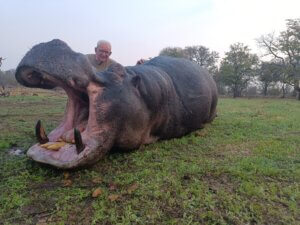
Appearance: Hippos are massive animals with barrel-shaped bodies, short legs, and large heads. They have thick, hairless skin that ranges in color from grayish-brown to purplish-gray, which secretes a reddish-colored oily substance that acts as a natural sunscreen. Hippos have short ears and small, round eyes positioned high on their heads, allowing them to see while submerged in water. They have large, tusk-like canine teeth and powerful jaws capable of crushing even the toughest vegetation.
Size: Adult hippos are among the largest land mammals, typically measuring between 3.5 to 5 meters (11 to 16 feet) in length and standing around 1.5 meters (5 feet) tall at the shoulder. They can weigh anywhere from 1,500 to 3,200 kilograms (3,300 to 7,000 pounds), with males being slightly larger and heavier than females.
Habitat: Hippos are primarily found in rivers, lakes, and swamps throughout sub-Saharan Africa, where they can spend most of their time submerged in water to stay cool and avoid the harsh sun. They prefer habitats with deep, slow-moving water and nearby grazing areas where they can feed on grasses and other vegetation.
Behavior: Hippos are mostly nocturnal, being most active during the night when temperatures are cooler. They are highly social animals and live in groups known as pods or bloats, which can consist of anywhere from a few individuals to several dozen members. Hippos are territorial animals, particularly dominant males, and will fiercely defend their territory and mates from intruders. Despite their docile appearance on land, hippos are known to be aggressive and territorial, especially when threatened or during the breeding season.
Diet: Hippos are herbivores, feeding primarily on grasses, aquatic plants, and other vegetation found along the banks of rivers and lakes. They have specialized dentition adapted for grazing, with large incisor and canine teeth for cutting and tearing vegetation, and flat molars for grinding plant material. Despite their large size, hippos are efficient grazers and can consume large quantities of vegetation in a single night.
Reproduction: Breeding among hippos can occur throughout the year, although peak mating seasons may vary depending on environmental conditions. After a gestation period of around eight months, females give birth to a single calf, which is usually born underwater. The calf remains close to its mother for several months, nursing and learning essential survival skills before becoming independent.