INFORMATION PURPOSES ONLY
 NAME: DUIKER RED
 SCIENTIFIC NAME: CEPHALOPHUS NATALENSIS
 WEIGHT: 14KG (M) 14KG (F)
 LIFESPAN: 12 YEARS
 ENEMY: LEOPARD, LION, CARACAL, PYTHON

NAME: DUIKER RED
SCIENTIFIC NAME: CEPHALOPHUS NATALENSIS
WEIGHT: 14KG (M) 14KG (F)
LIFESPAN: 12 YEARS
ENEMY: LEOPARD, LION, CARACAL, PYTHON
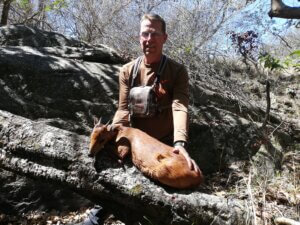
Appearance: Red duikers have a compact, slender body with short legs and a relatively short neck. They are named for their reddish-brown to chestnut-red fur, which is darker on the back and lighter on the underparts. They often have a distinctive crest of hair along their back. Red duikers have large, round ears and a short, tapered muzzle.
Size: Red duikers are among the smallest antelope species, typically standing around 30 to 40 centimeters (12 to 16 inches) tall at the shoulder. They can measure between 90 to 120 centimeters (35 to 47 inches) in length from the nose to the base of the tail. On average, they weigh between 10 to 20 kilograms (22 to 44 pounds), with males being slightly larger and heavier than females.
Habitat: Red duikers inhabit dense forests, thickets, and bushlands throughout eastern and southern Africa. They prefer habitats with dense undergrowth and ample cover, where they can hide from predators and browse on leaves, shoots, and fruits. Red duikers are often associated with riverine forests and other moist habitats.
Behavior: Red duikers are primarily solitary and crepuscular, meaning they are most active during the early morning and late afternoon. They are secretive animals and are often difficult to spot in the wild due to their shy nature and cryptic coloration. Red duikers are herbivores, feeding on a variety of plant matter including leaves, shoots, fruits, and flowers.
Communication: Red duikers communicate using a variety of vocalizations, body postures, and scent marking. They have specialized glands located on their face, feet, and between their hooves, which they use to mark their territory and communicate with other individuals in the area.
Reproduction: Breeding among red duikers can occur throughout the year, although peak mating seasons may vary depending on the region. After a gestation period of around six to seven months, females give birth to a single offspring, known as a fawn. The fawn is typically hidden in dense vegetation for protection during its early days and is nursed by its mother until it is old enough to forage on its own.