INFORMATION PURPOSES ONLY
 NAME: GEMSBUCK
 SCIENTIFIC NAME: ORYX GAZELLA
 WEIGHT: 240KG (M) 210KG (F)
 LIFESPAN: 19 YEARS
 ENEMY: SPOTTED HYENA, LION, WILD DOG

NAME: GEMSBUCK
SCIENTIFIC NAME: ORYX GAZELLA
WEIGHT: 240KG (M) 210KG (F)
LIFESPAN: 19 YEARS
ENEMY: SPOTTED HYENA, LION, WILD DOG
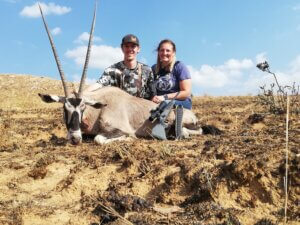
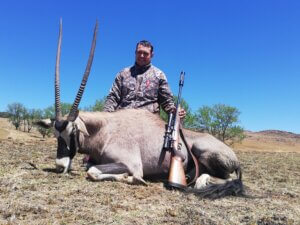
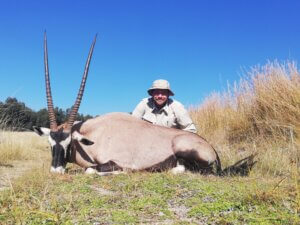
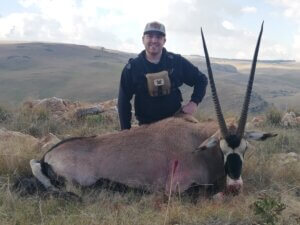
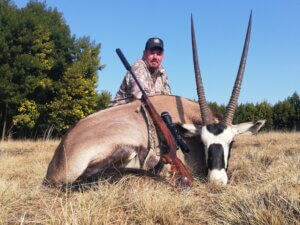
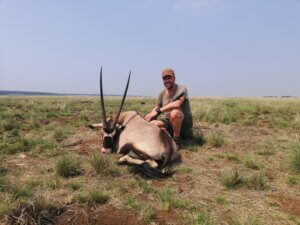
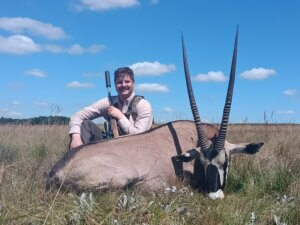
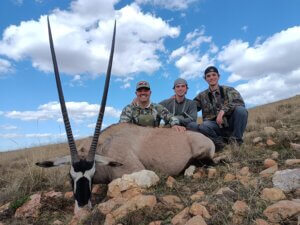
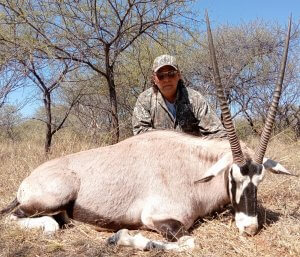
Appearance: Gemsbok are characterized by their striking appearance, featuring long, straight horns that extend backward from their heads. Both males and females have these horns, which are usually black and can grow up to 80-90 centimeters (31-35 inches) in length. They have a grayish-brown to sandy coat, with a lighter-colored underbelly. Gemsbok have distinct black markings on their face, extending from the eyes to the muzzle, which helps reduce glare from the sun. They also have a black stripe running along the sides of their body and down the outside of their legs.
Size: Gemsbok are large antelopes, typically standing around 1.2 to 1.4 meters (4 to 4.6 feet) tall at the shoulder. They can measure between 1.8 to 2.2 meters (5.9 to 7.2 feet) in length from the nose to the base of the tail. Adult gemsbok can weigh anywhere from 180 to 240 kilograms (400 to 530 pounds), with males generally being larger and heavier than females.
Habitat: Gemsbok are well-adapted to arid and semi-arid environments, including deserts, savannas, and scrublands throughout southern Africa. They are particularly common in the Kalahari Desert and other dry regions where they can survive with limited water sources. Gemsbok are able to extract moisture from the vegetation they consume and can go for extended periods without drinking water.
Behavior: Gemsbok are primarily diurnal, being most active during the early morning and late afternoon when temperatures are cooler. They are highly adapted to their harsh environment and can withstand extreme temperatures and drought conditions. Gemsbok are typically found in small herds consisting of females, their offspring, and sometimes a dominant male. They are agile runners and can reach speeds of up to 60 kilometers per hour (37 miles per hour) when fleeing from predators.
Diet: Gemsbok are herbivores, feeding on a variety of grasses, herbs, leaves, and succulent plants found in their arid habitat. They are also capable of browsing on thorny shrubs and trees, using their tough lips and strong jaws to extract nutritious vegetation even from spiky plants.
Reproduction: Breeding among gemsbok can occur throughout the year, although peak mating seasons may vary depending on environmental conditions. After a gestation period of around 8 to 9 months, females give birth to a single calf, which is able to stand and walk shortly after birth. The calf remains with its mother for protection and nourishment until it is old enough to forage on its own.